INNpresa Project: Business Innovation Observatory Key Insights, Patterns and Success Cases of Innovative Valencian Companies
Barra, R., Mateu, J. M., Abel, I., & Planas, L.
2023


| Year of publication: | 2023 |
|---|---|
| Authors: | Barra, R., Mateu, J. M., Abel, I., & Planas, L. |
| Categories: | Climate change adaptation solutions, ICT to assess and predict climate actions, Strategic intelligence and citizens’ participation, ICT systems improving resource efficiency, Eco-innovation and green economy transition |
INNpresa Project: Observatory of Innovation in Business. Keys, Patterns, and Case Studies of Successful Innovative Valencian Companies is a publication that examines the practices, strategies, and management models that characterize successful innovative companies in the Valencian Community (EVIEs). Developed within the framework of the INNpresa Project, promoted by the Science Park Foundation of the University of Valencia and supported by the Valencian Innovation Agency, the book aims to identify and disseminate the factors that enable certain companies to transform innovation into a sustainable competitive advantage. Based on in-depth interviews with innovation managers and executives from leading Valencian companies, the study explores four key areas: the generation and management of innovative ideas and technologies, innovation development and implementation processes, the role of people and organizational culture in fostering innovation, and the relationship between innovation and business strategy. Throughout its chapters, the publication addresses topics such as technology intelligence, competitive intelligence, digital transformation, agile methodologies, design thinking, open innovation, collaboration with startups, innovative talent management, and the strategic patterns followed by highly innovative firms. It also includes numerous case studies illustrating how these organizations leverage innovation to achieve growth, differentiation, and the creation of economic and social value. More than a descriptive report, the book serves as a practical guide for business leaders, entrepreneurs, innovation managers, researchers, and policymakers seeking to understand how organizations can strengthen their competitiveness through innovation. Combining empirical evidence, strategic analysis, and real-world examples, it offers valuable lessons that can be applied across industries and organizations of different sizes.
| Tags: | |
|---|---|
| Date: | 05.06.2026 |

| Year of publication: | 2026 |
|---|---|
| Authors: | Rafael Popper, Monika Popper, Guillermo Velasco, Mattia Martini, Angela Rizzo |
| Categories: | Strategic intelligence and citizens’ participation, Solutions to explore, extract, process and recycle, Solutions for water imbalances, Solutions for cultural heritage assets, Resource efficient sustainable lifestyles, Raw materials conscious sustainable lifestyle, Long-term raw materials availability, ICT to assess and predict climate actions, ICT systems to map raw materials trends, ICT systems improving resource efficiency, ICT mapping natural resources and trends, Effective raw materials policies, Eco-solutions to reduce raw materials use, Eco-innovation and green economy transition, Climate change projections and scenarios, Climate change mitigation solutions, Climate change adaptation solutions, Climate action eco-innovation policies, Climate action by sustainable lifestyle, Biodiversity examination and understanding, Awareness on raw materials shortage, Alternative raw materials |
This paper introduces the Hundred and Fifty Shades of Green Playbook – an evidence-based, foresight-driven instrument for assessing and managing Sustainable Innovation (SI). Building on the CASI Project (2014–2017) and its successor applications in the BOLERO Project (2022–2025), with further implementation in the CASI-BIO project (2026–2030), the Playbook proposes a sequenced, action-oriented approach for multi-actor collaboration. It integrates stakeholder engagement, critical-issues analysis, and foresight-based planning into ten interlinked governance aspects encompassing 150 meta-tasks that guide sustainability-oriented decision-making across government, business, academia, and civil society. The BOLERO experience, particularly the MOBBI service innovation in Lombardy, exemplifies the framework’s transferability from EU-level to regional implementation, demonstrating its adaptability to diverse institutional and socio-economic contexts. Reflecting a decade of progress in the governance and management of sustainable innovation, the Playbook’s Action Roadmap and Strategic Framework link strategic foresight with participatory governance and sustainability assessment. Together, they offer a replicable model for building resilient, impact-driven innovation ecosystems that directly support the Sustainable Development Goals (SDGs) and align with Environmental, Social, and Governance (ESG) principles. Future research will deepen longitudinal evaluation and continuous learning to ensure that sustainable innovation practices continue to evolve and shape the future. View Article
| Tags: | sustainable innovation, sustainability assessment, innovation management, Foresight, action roadmapping, ecosystem resilience |
|---|---|
| Date: | 01.03.2026 |

| Year of publication: | 2025 |
|---|---|
| Authors: | Monika Popper, Rafael Popper, Carina Alejandra Rapetti, Josep Miquel Pique |
| Categories: | Strategic intelligence and citizens’ participation, Resource efficient sustainable lifestyles, Eco-solutions to reduce raw materials use, Eco-innovation and green economy transition, Climate change projections and scenarios, Climate change mitigation solutions, Climate change adaptation solutions, Climate action eco-innovation policies, Climate action by sustainable lifestyle |
This paper explores the integration of DIY (Do-It-Yourself) and crowdsourcing-driven innovation management with top-down policy frameworks to advance the European Green Deal and sustainability transitions. Drawing on the CASI (Common Framework for the Assessment and Management of Sustainable Innovation) project, it examines how CASI-F and its CASIPEDIA platform — a repository of over 700 sustainable innovation initiatives — can bridge local and global sustainability goals. Using a quadruple helix approach, the study highlights the role of innovation ecosystems in driving systemic change through the alignment of technological, economic, social, and environmental objectives. The paper compares the CASI SI agendas with the European Green Deal and sustainability transition agendas, identifying synergies, gaps, and opportunities for further alignment. Foresight is emphasised as a crucial tool to ensure innovation strategies remain adaptable, future-oriented, and resilient to emerging challenges. The findings underscore the importance of integrating grassroots innovations into broader policy frameworks to enhance sustainability transitions. Lastly, the paper recommends strengthening the Green Deal by fostering innovations from diverse actors, including those from the quadruple helix, and promoting the application of SMART foresight processes. View Article
| Tags: | sustainability transitions , innovation ecosystems , European Green Deal , crowdsourcing-driven innovation , quadruple helix , sustainable innovation agendas , foresight methodology , climate-neutral future |
|---|---|
| Date: | 15.05.2025 |

| Year of publication: | 2020 |
|---|---|
| Authors: | Mattia Martini, Rick Hölsgens, Rafael Popper |
| Categories: | Strategic intelligence and citizens’ participation, Solutions to explore, extract, process and recycle, Solutions for water imbalances, Solutions for cultural heritage assets, Resource efficient sustainable lifestyles, Raw materials conscious sustainable lifestyle, Long-term raw materials availability, ICT to assess and predict climate actions, ICT systems to map raw materials trends, ICT systems improving resource efficiency, ICT mapping natural resources and trends, Effective raw materials policies, Eco-solutions to reduce raw materials use, Eco-innovation and green economy transition, Climate change projections and scenarios, Climate change mitigation solutions, Climate change adaptation solutions, Climate action eco-innovation policies, Climate action by sustainable lifestyle, Biodiversity examination and understanding, Awareness on raw materials shortage, Alternative raw materials |
Sustainable innovation (SI) is considered to be a key driver of societal progress in an era of enormous economic, environmental and societal challenges, and the uncertainties and future consequences that come with them. This book provides evidence, insights and reflections related to specific issues of governance, the management of sustainable innovation and applying a multi-level, multi-stakeholder approach to sustainable innovation analysis. Building on the European Commission (EU) funded research project “Public Participation in Developing a Common Framework for the Assessment and Management of Sustainable innovation” (CASI), it presents tools for assessing and managing sustainable innovation, and reflects on SI-related policies as well as citizens’ aspirations. The book is intended for scholars in the field of sustainable innovation, as well as to policymakers, innovators, students and citizens. View Book
| Tags: | Participatory governance, Social innovation, Stakeholder engagement, Sustainability, Sustainable innovation, European Union politics, Foresight, Innovation policy |
|---|---|
| Date: | 01.08.2020 |

| Year of publication: | 2017 |
|---|---|
| Authors: | Rafael Popper, Monika Popper, Guillermo Velasco |
| Categories: | Strategic intelligence and citizens’ participation, Resource efficient sustainable lifestyles, Eco-solutions to reduce raw materials use, Eco-innovation and green economy transition, Climate change projections and scenarios, Climate change mitigation solutions, Climate change adaptation solutions, Climate action eco-innovation policies, Climate action by sustainable lifestyle |
This article presents new concepts and practical approaches resulting from the piloting of CASI-F - a common framework for the assessment and management of sustainable innovation (SI). Based on lessons learned from action research carried out in the context of the EU funded CASI project, the article focuses on the meta-analysis of 46 action roadmaps produced with 43 innovators supporting the practical application of CASI-F. The applied methodology helped to demonstrate that a multi-level and multi-actor advice approach promotes a shift towards improved understanding of innovations-related critical issues (barriers, drivers, opportunities and threats) and stakeholders’ relations, as well as their management, thus promoting the sustainable resilience and transformation of socio-technical systems. This paper first reflects on how we arrived to managerial lessons from the actions roadmaps and how could these lessons be used to assess the current state of affairs and potential way forward for European initiatives and instruments promoting sustainable innovation. View Article
| Tags: | sustainable innovation , management , resilience , action roadmaps |
|---|---|
| Date: | 01.12.2017 |
| Year of publication: | 2017 |
|---|---|
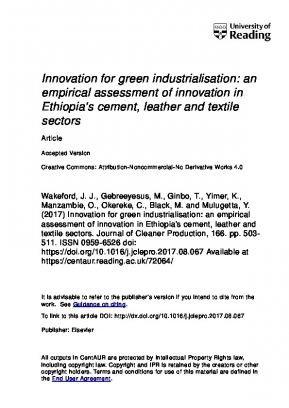
| Authors: | Wakeford, J. J., Gebreeyesus, M., Ginbo, T., Yimer, K., Manzambie, O., Okereke, C., Black, M. and Mulugetta, Y. |
| Categories: | Climate change mitigation solutions, ICT mapping natural resources and trends, Solutions for water imbalances, Eco-innovation and green economy transition, Solutions to explore, extract, process and recycle, ICT systems to map raw materials trends, Eco-solutions to reduce raw materials use |
This is a fascinating article that delves into the complexities of green industrialization in Ethiopia, focusing on the cement, leather, and textile sectors. Here's a breakdown of the key takeaways: Ethiopia's Ambitious Goals: The country aims to become a middle-income nation while simultaneously pursuing a low-carbon development path. This is encapsulated in their Growth and Transformation Plans (GTPs) and Climate Resilient Green Economy Strategy (CRGE). The challenge lies in boosting industrial production, which is currently quite low, while keeping greenhouse gas emissions in check. The Vital Role of Green Innovation: The authors emphasize that green innovation is crucial for achieving these goals. This means developing and implementing new technologies and practices that improve resource efficiency and reduce environmental impact. They highlight the lack of empirical studies on this topic in developing countries, making their research particularly valuable. Key Findings from the Study: Low Innovation Rates: The study found disappointingly low rates of product and process innovation in the three sectors. This is attributed to factors like high technology costs, limited access to finance, and inadequate information. Focus on Competitiveness: A concerning finding is that firms are primarily driven by competitiveness, with environmental concerns and regulatory compliance being low priorities. Importance of Collaboration: The research underscores the importance of strong interactions between firms, government agencies, and research institutions to foster innovation. Recommendations for Greening Ethiopia's Industries: Enhanced Coordination: Better coordination among key actors is essential. This includes government ministries, research institutions, and industry players. Financial Incentives: Providing financial support to firms can encourage them to invest in green technologies and practices. Stronger Enforcement: Stricter enforcement of environmental regulations is needed to push firms towards greener practices.
| Tags: | |
|---|---|
| Date: | 17.02.2025 |

| Year of publication: | 2019 |
|---|---|
| Authors: | Md. Wahid Rezwan |
| Categories: | Strategic intelligence and citizens’ participation, ICT systems improving resource efficiency |
VTMS "Vehicle Tracking & Traffic Monitoring System" is a system used to control/monitor traffic system. It is a combination of Two Devices and Some Sensors. Some Sensors will be placed at every Traffic Signal Points and at different areas, Some are at every Vehicles. Two devices / (would be Mobile), one for Traffic Sargent & another for Drivers as well as the owner of commercial vehicle. This will decrease the no. of accident.
| Tags: | Traffic, Accident, Jam, Road |
|---|---|
| Date: | 13.07.2019 |
| Year of publication: | 2017 |
|---|---|
| Authors: | Schultze, Jürgen; Berchem, Marina; Hölsgens, Rick; Repo, Petteri; Matschoss, Kaisa |
| Categories: | Strategic intelligence and citizens’ participation, Eco-innovation and green economy transition, Climate change adaptation solutions, Climate action eco-innovation policies |
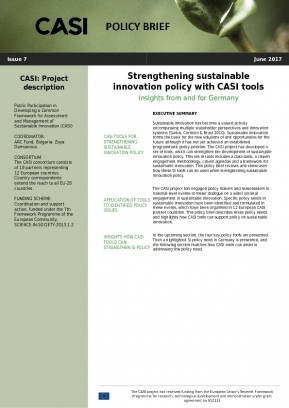
Sustainable innovation forms the basis for the new solutions of and opportunities for the future although it has not yet achieved an established programmatic policy position. The CASI project has developed a set of tools, which can strengthen the development of sustainable innovation policy. This set of tools includes a data bank, a citizen engagement methodology, citizen agendas and a framework for sustainable innovation. This policy brief reviews and showcases how these SI tools can be used when strengthening sustainable innovation policy. In Germany, the identified policy need is to support the creation of new forms of dialogue and joint solution development between different stakeholder groups or political levels and the involvement and empowerment of civil society and citizens.
| Tags: | CASI tools, sustainable innovation policy, citizen engagement, methodology, Germany |
|---|---|
| Date: | 07.06.2017 |
| Year of publication: | 2017 |
|---|---|
| Authors: | Cergol Lipnik, Maja; Lipnik Aleš; Repo, Petteri; Matschoss, Kaisa |
| Categories: | Strategic intelligence and citizens’ participation, Eco-innovation and green economy transition, Climate change adaptation solutions, Climate action eco-innovation policies |
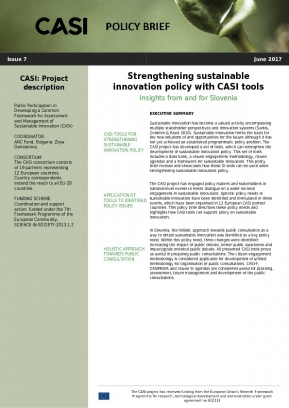
Sustainable innovation forms the basis for the new solutions of and opportunities for the future although it has not yet achieved an established programmatic policy position. The CASI project has developed a set of tools, which can strengthen the development of sustainable innovation policy. This set of tools includes a data bank, a citizen engagement methodology, citizen agendas and a framework for sustainable innovation. This policy brief reviews and showcases how these SI tools can be used when strengthening sustainable innovation policy. In Slovenia, the holistic approach towards public consultation as a way to obtain sustainable innovation was identified as a key policy need. All presented CASI tools prove as useful in preparing public consultations. The citizen engagement methodology is considered applicable for development of unified methodology for organisation of public consultations.
| Tags: | CASI tools, sustainable innovation policy, citizen engagement, methodology, Slovenia |
|---|---|
| Date: | 07.06.2017 |
| Year of publication: | 2017 |
|---|---|
| Authors: | Pinto, Marta; Azevedo, Catarina; Repo, Petteri; Matschoss, Kaisa |
| Categories: | Strategic intelligence and citizens’ participation, Eco-innovation and green economy transition, Climate change adaptation solutions, Climate action eco-innovation policies |
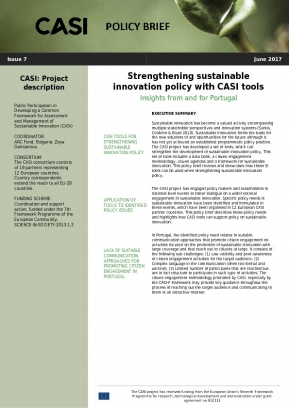
Sustainable innovation forms the basis for the new solutions of and opportunities for the future although it has not yet achieved an established programmatic policy position. The CASI project has developed a set of tools, which can strengthen the development of sustainable innovation policy. This set of tools includes a data bank, a citizen engagement methodology, citizen agendas and a framework for sustainable innovation. This policy brief reviews and showcases how these SI tools can be used when strengthening sustainable innovation policy. In Portugal, the identified policy need relates to suitable communication approaches that promote citizen engagement on activities focused on the promotion of sustainable innovation with large coverage and that reach out to citizens at large. The citizen engagement methodology promoted by CASI, especially by the CASI-F framework may provide key guidance throughout the process of reaching out the target audience and communicating to them in an attractive manner.
| Tags: | CASI tools, sustainable innovation policy, citizen engagement, methodology, Portugal |
|---|---|
| Date: | 07.06.2017 |

Barra, R., Mateu, J. M., Abel, I., & Planas, L.
2023

Rafael Popper, Monika Popper, Guillermo Velasco, Mattia...
2026

Monika Popper, Rafael Popper, Carina Alejandra Rapetti,...
2025

Mattia Martini, Rick Hölsgens, Rafael Popper
2020

Rafael Popper, Monika Popper, Guillermo Velasco
2017

Wakeford, J. J., Gebreeyesus, M., Ginbo, T., Yimer, K.,...
2017

Md. Wahid Rezwan
2019

Schultze, Jürgen; Berchem, Marina; Hölsgens, Rick; Repo,...
2017

Cergol Lipnik, Maja; Lipnik Aleš; Repo, Petteri;...
2017

Pinto, Marta; Azevedo, Catarina; Repo, Petteri;...
2017