
From Evidence to Action
Sustainability is not held back by a lack of ambition. Strategies, frameworks, and targets are everywhere. The real challenge lies elsewhere – in turning that ambition into action.
This is the starting point of A Hundred and Fifty Shades of Green. Rather than asking what sustainable innovation should look like, the work asks a more practical question: how can it actually be governed?
Learning from Practice
The answer comes from experience. The CASI project analysed hundreds of innovation cases across Europe, later expanded through CASIPEDIA and applied in real-world contexts. Over time, a clear pattern emerged.
Sustainable innovation does not fail because of weak ideas. It fails because the surrounding conditions are fragmented – actors are not aligned, resources are uneven, and promising initiatives struggle to scale.
Why a Playbook Matters
This is where the Playbook makes a difference. It translates years of evidence into something actionable: ten interconnected aspects of governance and 150 meta-tasks that help move from intention to implementation.
The message is simple but powerful. Sustainability is not one-dimensional. It requires many coordinated actions – many “shades” – working together.
From Framework to Action
What makes the Playbook useful is its focus on practice. It does not stop at explaining complexity. It helps navigate it.
Through an Action Roadmap, organisations can move step by step – from understanding their context, to aligning stakeholders, to experimenting, learning, and scaling solutions. Sustainability becomes less abstract and more manageable.
The Role of the Quadruple Helix
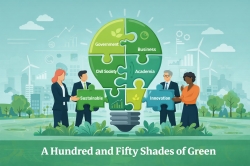
At the centre of this approach is the interaction between government, business, academia, and civil society.
Sustainable innovation is strongest when these actors work together – combining direction, implementation, knowledge, and societal engagement. It is this coordination, rather than any single breakthrough, that drives real change.
A Final Reflection
The “hundred and fifty shades” are not about complexity for its own sake. They represent the many ways in which sustainability can be shaped, guided, and realised.
The challenge is not finding the right idea. It is connecting the right actions.
Explore the full article
If you would like to explore the full Playbook, including the 150 meta-tasks and Action Roadmap, you can read the article here:
https://doi.org/10.17323/fstig.2025.29768
Relevant themes:
Public participation, Sustainable innovation, Raw materials, Resource efficiency, Environment, Climate action
Relevant tags: Social innovation, Technological innovation, Sustainability, Eco-innovation, Sustainable lifestyles, Sustainable materials management, Circular economy, Energy policy