Three Worlds, One Challenge
Sustainability transitions are often described as complex.
But complexity is not the real problem.
The real challenge is fragmentation.
Across Europe, three powerful but largely disconnected “worlds” are shaping the transition to sustainability:
-
policymakers defining ambitious goals
-
researchers developing conceptual frameworks
-
innovators experimenting with real-world solutions
Each of these worlds is essential.
Yet too often, they evolve in parallel rather than in alignment.
The result is a familiar gap between what is done, what is understood, and what is intended.
Three Agendas, Three Perspectives
The contribution of the CASI-based research lies in making this fragmentation visible – and actionable.
It does so by bringing together three distinct types of agendas.
Sustainable Innovation Agendas – Practice in Action
The first set of agendas emerges from practice.
Built from hundreds of real initiatives across Europe, the CASI sustainable innovation agendas reflect what innovators are already doing – in communities, businesses, and local ecosystems.
They are grounded, experimental, and often highly context-specific. They show how sustainability is being shaped through:
-
local energy solutions
-
circular economy initiatives
-
community resilience practices
These agendas do not start with theory or policy. They start with action.
Sustainability Transition Agendas – Understanding Change
The second set of agendas comes from research.
Developed within the sustainability transitions field, they focus on understanding how systemic change happens. They explore:
-
power dynamics
-
governance structures
-
social practices
-
cultural and ethical dimensions
These agendas do not prescribe solutions. They provide explanations.
They help us understand why transitions are slow, contested, and uneven – and why technological change alone is never enough.
European Green Deal Agendas – Direction and Ambition
The third set of agendas is policy-driven.
The European Green Deal defines a clear direction – towards climate neutrality, resource efficiency, and systemic transformation. It sets targets, priorities, and investment frameworks across sectors such as:
-
energy
-
mobility
-
food systems
-
industry
These agendas are ambitious and necessary. They answer the question: what should be done?
From Fragmentation to Alignment
Seen together, these three agenda types reveal something fundamental.
They are not competing perspectives.
They are complementary layers of the same transformation.
-
Practice shows what is possible
-
Research explains how change unfolds
-
Policy defines where we want to go
And yet, without integration, each remains incomplete.
- Innovation without policy struggles to scale.
- Policy without practice risks irrelevance.
- Theory without connection risks abstraction.
The core contribution of this work is to move beyond comparison – and towards alignment.
What the Comparison Reveals
When these agendas are systematically analysed side by side, clear patterns begin to emerge.
There is strong convergence around key themes:
-
climate action and decarbonisation
-
circular economy and resource efficiency
-
sustainable mobility and energy systems
-
social inclusion and justice
-
governance and systemic coordination
But there are also important gaps.
- Local innovations often lack visibility and scaling pathways.
- Policy frameworks sometimes overlook social and community dimensions.
- Research highlights complexity, but does not always translate into action.
The issue is not lack of ideas – it is lack of connection between them.
The Missing Link: Who Drives Change?
This is where the paper makes its most distinctive contribution.
It does not stop at comparing agendas. It asks a deeper question: who is actually driving these agendas?
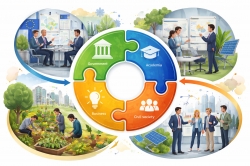
Using the quadruple helix framework, the analysis maps the role of government, business, academia, and civil society across all three agenda types.
What emerges is not balance – but asymmetry:
- Governments dominate policy agendas.
- Businesses lead in scaling solutions.
- Academia shapes theoretical understanding.
- Civil society drives grassroots innovation and legitimacy.
Each plays a critical role – but not always in the same places, or with the same intensity.
The Quadruple Helix as Integration Mechanism
The insight is powerful.
Sustainability transitions are not just about aligning ideas –
they are about aligning actors.
The quadruple helix becomes more than a framework.
It becomes a mechanism for integration.
Where collaboration is strong across all four actors:
-
innovation accelerates
-
policies become more grounded
-
transitions become more inclusive
Where one or more actors are missing:
-
fragmentation persists
-
implementation slows
-
legitimacy weakens
In this sense, the transition is not only technological or economic.
It is fundamentally relational.
A Shift in How We Think About Transitions
This leads to a broader shift in perspective.
We often think of sustainability transitions as something to be designed and implemented.
But the evidence suggests something different.
They must be:
-
co-created across levels
-
coordinated across agendas
-
co-driven by multiple actors
The question is no longer: “Which approach is best?”
But rather: How do we align them effectively?
A Final Reflection
Europe does not lack innovation. It does not lack policy ambition. It does not lack knowledge.
What it lacks – and what this work addresses – is alignment.
Between:
-
local action and global strategy
-
theoretical insight and practical implementation
-
policy direction and societal engagement
And ultimately, between the actors who make change possible.
Because sustainability transitions do not happen in silos.
They happen when innovation, policy, and understanding move together.
Explore the full paper
If you would like to explore the full analysis, including the comparative framework and the quadruple helix matrix, you can read the article here:
https://doi.org/10.2478/emj-2025-0009
Relevant themes:
Public participation, Sustainable innovation, Raw materials, Resource efficiency, Environment, Climate action
Relevant tags: Social innovation, Technological innovation, Sustainability, Eco-innovation, Sustainable lifestyles, Sustainable materials management, Circular economy, Energy policy