
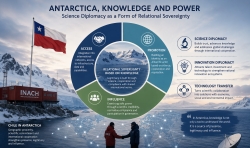
When we think about diplomacy, we usually picture embassies, negotiations, and international treaties. When we think about science, we tend to imagine laboratories, researchers, and the production of knowledge. Today, however, the boundaries between these two worlds are becoming increasingly blurred. The growing complexity of global challenges has pushed states to incorporate scientific knowledge as an increasingly important component of their international engagement.
Few places illustrate this transformation better than Antarctica.
Often perceived as a remote and isolated territory, the white continent represents one of the most remarkable experiments in international governance in modern history. It is a space where climate change, biodiversity conservation, scientific research, extreme logistics, and international relations converge. What makes Antarctica truly exceptional is that these dynamics unfold within a regime deliberately designed to limit traditional forms of geopolitical competition.
The Antarctic Treaty System, in force since 1961, established principles that remain unique in contemporary international politics: the peaceful use of the continent, freedom of scientific research, international cooperation, information exchange, and environmental protection. At a time when geopolitical tensions are intensifying across the globe, Antarctica remains one of the few places where scientific cooperation serves as a primary source of legitimacy.
This characteristic fundamentally reshapes how states build presence and influence.
Science as a Form of International Presence
Chile occupies a particularly interesting position within this landscape. As an original signatory of the Antarctic Treaty, with geographic proximity to the continent and the strategic importance of the Magallanes Region, the country enjoys several advantages. Yet the Antarctic experience demonstrates that geography alone does not guarantee influence.
In Antarctica, legitimacy is built through science.
Sustained research activities, international cooperation, participation in multinational programs, and contributions to global knowledge all strengthen a country's position within the Antarctic system. Presence is measured not only through stations and infrastructure, but also through the ability to generate relevant knowledge and share it with the international community.
In this effort, the Chilean Antarctic Institute (INACH) has played a fundamental role. Since its establishment in 1964, it has contributed to the development of national scientific capabilities, promoted international cooperation, and strengthened Chile’s participation in major polar research initiatives. Its work has connected universities, research centers, and scientists with global knowledge networks, making it one of the principal instruments of Chilean presence in Antarctica.
Complementing this scientific role, Chile’s Ministry of Foreign Affairs has been responsible for articulating the diplomatic dimension of the country’s Antarctic strategy. Chilean Antarctic policy is not built solely through scientific research but also through the capacity to project that activity into multilateral arenas where norms, priorities, and cooperative mechanisms are negotiated. In this context, science and diplomacy do not operate as separate spheres; they function as interdependent dimensions of the same international strategy.
Beyond Cooperation: Knowledge and Legitimacy
The literature on science diplomacy often highlights three principal functions: the use of scientific evidence to inform international decision-making, the facilitation of scientific cooperation through diplomatic channels, and the use of science as a tool for strengthening relations among countries.
All these dimensions are important. Yet the Antarctic experience reveals an additional dynamic.
Science does not merely facilitate cooperation; it also generates legitimacy.
When a country actively contributes to scientific knowledge, participates in global climate monitoring, shares information, and complies with demanding environmental standards, it is doing more than producing research. It is building trust. And within governance systems based on cooperation, trust becomes a source of political influence.
This observation is particularly important because it challenges traditional interpretations of sovereignty. For centuries, sovereignty has been understood primarily in terms of territorial control and exclusive authority. Antarctica suggests a different reality. There, influence depends less on controlling territory and more on contributing to the functioning of the system itself.
One could argue that we are witnessing an emerging form of knowledge-based relational sovereignty.
This is not a form of sovereignty that disappears. Rather, it is a form that expresses itself differently—through participation in scientific networks, the production of evidence, compliance with international norms, and the capacity to generate trust.
Science Diplomacy, Innovation Diplomacy, and Technology Transfer
The Antarctic experience also invites reflection on a growing issue: the relationship between science diplomacy and innovation diplomacy.
Although the two concepts are often used interchangeably, they respond to different logics.
Science diplomacy is primarily oriented toward strengthening international cooperation through knowledge. It seeks to connect scientific communities, facilitate joint research, and provide evidence to address shared challenges.
Innovation diplomacy, by contrast, incorporates a more explicit economic dimension. Its purpose is to attract talent, investment, technology, and capabilities that can strengthen national innovation ecosystems and improve competitiveness.
The distinction is subtle but important. Science diplomacy treats knowledge primarily as a global public good, while innovation diplomacy also regards it as a strategic asset for economic development and competitiveness.
Yet both converge on a critical point: technology transfer.
International scientific cooperation creates networks, trust, and access to capabilities that can later support innovation processes. Research conducted in extreme environments such as Antarctica has historically contributed to advances in environmental monitoring, observation technologies, energy systems, advanced logistics, and data analysis methodologies.
For this reason, science should not be viewed solely as an academic activity. It is also a strategic investment capable of generating long-term economic, social, and technological benefits.
Antarctica as a Laboratory of the Future
Perhaps the most important lesson offered by the Antarctic experience is that knowledge is becoming increasingly central to international politics.
Throughout much of the twentieth century, international influence was associated with factors such as economic size, natural resources, and military capabilities. These factors remain important. Yet the twenty-first century is introducing new sources of power.
The ability to produce knowledge, participate in international networks, manage strategic information, and contribute to solving global challenges is becoming an increasingly valuable asset.
In this sense, Antarctica functions as a laboratory of the future.
What we observe there today may anticipate some of the defining characteristics of tomorrow’s global governance: deeper cooperation, greater reliance on scientific knowledge, and a growing importance of institutional trust.
Chile possesses favorable conditions to play a significant role in this evolving landscape. Yet doing so will require continued investment in scientific capabilities, stronger institutions such as INACH, closer coordination with the Ministry of Foreign Affairs, and more effective connections between research, innovation, and public policy.
The central lesson is simple, yet profound. In certain areas of contemporary international politics, knowledge is no longer merely a tool for understanding the world. It has become a source of presence, legitimacy, and influence.
And that may well be one of the most important transformations of our time.
Relevant themes:
Sustainable innovation, Environment, Climate action, Public participation
Relevant tags: Technological innovation, Sustainability, Sustainable materials management, Circular economy, Energy policy