Over the last few decades, much of the debate on innovation and development has revolved around a seemingly simple question: how much should we invest to innovate more?
The dominant answer has been relatively consistent. Increasing expenditure on research and development (R&D), strengthening business support programmes, expanding funding for universities and technological centres, and promoting incentives for the adoption of new technologies should translate into higher levels of innovation and, consequently, improved economic and social performance.
However, accumulated evidence suggests that the relationship between investment and innovation is far less linear than commonly assumed.
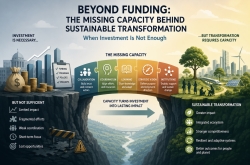
Many territories have steadily increased their investments in science, technology and innovation without successfully translating these efforts into significant gains in productivity, productive diversification, or sustainable solutions to the social and environmental challenges they face. This suggests that the availability of financial resources is a necessary, but not sufficient, condition for fostering sustainable transformation.
The relevant question, therefore, is not only how much is invested, but also what capacities exist to transform that investment into structural change.
The Innovation Paradox
Chile provides a particularly illustrative case.
Over recent decades, the country has strengthened its public institutions, developed innovation support instruments, and progressively increased investment in scientific and technological activities. Nevertheless, the outcomes achieved have been more modest than expected in areas such as productivity, economic sophistication, and the development of endogenous technological capabilities.
This situation is not unique to Chile. Many economies face a similar paradox: they possess programmes, instruments and resources, yet struggle to generate sustained processes of economic and social transformation.
The explanation appears to lie less in the availability of funding and more in the capacity of innovation systems to coordinate actors, mobilise knowledge, and direct innovation towards shared strategic objectives.
Innovation as a Systemic Phenomenon
Contemporary approaches to innovation have moved beyond the traditional view that innovation is exclusively the result of scientific research or individual entrepreneurial initiative.
Sustainable innovation emerges, rather, as a systemic phenomenon that depends on interactions among multiple actors: governments, businesses, universities, research centres and civil society.
Each contributes distinct capabilities.
Governments provide strategic vision, regulatory frameworks and coordination mechanisms.
Businesses transform knowledge into scalable and economically viable solutions.
Universities and research centres generate new knowledge and strengthen human capabilities.
Civil society contributes needs, values and perspectives that help direct innovation towards socially relevant goals.
The ability to articulate these contributions is one of the main determinants of successful innovation systems.
The Challenge of Coordination
One of the most important lessons derived from studies on innovation and sustainability transitions is that transformation processes depend as much on coordination as on the availability of resources.
Coordination involves aligning objectives, sharing information, building trust among stakeholders, creating spaces for collective learning, and sustaining long-term visions.
When these capabilities are weak, innovation systems tend to be characterised by high levels of institutional fragmentation. Multiple initiatives may exist, but connections between them remain limited. Programmes operate independently, organisations pursue similar objectives without effective collaboration mechanisms, and many innovations remain confined to small-scale applications, unable to expand or generate systemic impacts.
In such contexts, the problem is not a lack of innovative activity, but rather the absence of strategic alignment.
From Administrative Capacity to Transformative Capacity
Traditionally, state capacity has been assessed in terms of administrative efficiency: executing budgets, designing programmes, or implementing regulations.
While these functions remain essential, contemporary challenges require additional capabilities.
The energy transition, climate adaptation, population ageing, digitalisation, and growing territorial inequalities demand what some scholars describe as transformative capacity.
This refers to the ability to anticipate change, build shared visions, mobilise diverse actors, foster learning processes, and adapt to complex and uncertain environments.
Sustainable innovation requires precisely these capabilities. The challenges it seeks to address are systemic in nature and cannot be solved by a single organisation, discipline or level of government.
Knowledge as Invisible Infrastructure
There is also a frequently underestimated dimension within innovation policy.
The most innovative societies are not necessarily those endowed with the greatest natural resources or the largest markets. Rather, they are those that have succeeded in building ecosystems where knowledge circulates effectively.
Innovation depends on cultures of learning, collaborative networks, mechanisms for experimentation, and environments where failure is recognised as a source of learning rather than merely a setback.
From this perspective, knowledge functions as an invisible infrastructure, as essential to development as roads, ports, or energy networks.
When this infrastructure is weak, even the most ambitious investments encounter limits in generating lasting impacts.
Innovation with Purpose
Sustainable innovation also introduces a fundamental question: why do we innovate?
Innovation outcomes are often evaluated through indicators such as patents, exports, productivity, or economic growth. All of these are important, yet they remain insufficient for understanding innovation’s broader contribution to development.
Sustainable innovation encourages a broader perspective by incorporating criteria related to collective well-being, territorial cohesion, social inclusion, resilience, and environmental sustainability.
Innovation thus ceases to be an end in itself and becomes a means of building more sustainable and inclusive futures.
Final Reflection
Major transformations do not occur simply because funding is available.
Nor do they occur merely because a new technology emerges or a new public policy is approved.
Transformations take place when resources, knowledge, institutions and values converge around a shared direction.
The key question for the coming years should not be limited to how much we invest in innovation.
The truly strategic challenge is whether we are developing the institutional, organisational and social capacities required to transform investment into collective learning, effective coordination, and sustainable prosperity.
Because sustainability depends not only on our capacity to innovate, but above all on our capacity to learn, collaborate, and act with purpose.
Relevant themes:
Public participation, Sustainable innovation, Resource efficiency
Relevant tags: Technological innovation, Sustainability, Sustainable lifestyles