The energy transition is reshaping how countries design their development strategies. In this context, green hydrogen has emerged as one of the most promising pathways towards a low-carbon economy. Yet one fundamental question remains: is abundant renewable energy enough for a country to become a global leader in this emerging industry?
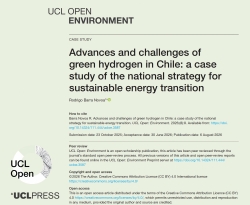
My recent research, published in UCL Open Environment (UCL Press, University College London), addresses this question through an analysis of Chile’s National Green Hydrogen Strategy, evaluating it as a public policy instrument designed to accelerate the energy transition, support decarbonisation and promote sustainable development.
A Different Perspective
Unlike much of the existing literature, which primarily focuses on the technological or economic feasibility of green hydrogen, this study provides an integrated assessment of Chile’s strategy by examining its institutional, regulatory, technological, economic, territorial and governance dimensions within a single analytical framework.
This broader perspective demonstrates that the development of a green hydrogen economy depends not only on the availability of renewable resources, but also on the capacity of governments to design coherent public policies, coordinate public and private stakeholders, and strengthen innovation ecosystems capable of creating greater domestic value.
What Does the Research Reveal?
The findings show that Chile possesses exceptional conditions to become one of the world's leading players in the green hydrogen economy.
Among its key strengths are:
- exceptional solar and wind energy resources;
- a long-term national strategy with clear objectives;
- a relatively robust institutional framework;
- growing international cooperation; and
- strong investor interest, reflected in more than 80 announced hydrogen-related projects.
However, the research also demonstrates that these advantages alone are not sufficient to guarantee international leadership.
The Remaining Challenges
The study identifies several structural bottlenecks that must be addressed to build a competitive and sustainable hydrogen industry:
- technological dependence on imported equipment, particularly electrolysers;
- high production costs and uncertainty regarding future competitiveness;
- insufficient transport, storage and export infrastructure;
- challenges related to sustainable water management;
- the need to strengthen territorial governance and social acceptance of projects; and
- limited domestic value creation across the hydrogen value chain.
What Must Chile Do Next?
One of the central messages of this research is that the real challenge is no longer simply producing green hydrogen, but building a knowledge-based industry supported by innovation and domestic technological capabilities.
Achieving this objective will require greater investment in research, development and innovation (R&D&I), the development of local suppliers, stronger domestic supply chains, improved logistics and port infrastructure, specialised human capital, and closer coordination between government, academia, industry and regional stakeholders.
Only through these efforts will Chile be able to transform its comparative advantage—its exceptional renewable energy resources—into a sustainable competitive advantage capable of generating innovation, high-quality employment, regional development and long-term economic opportunities.
Ultimately, this research argues that leadership in the green hydrogen economy will depend not only on the abundance of renewable resources, but also on a country's ability to transform that potential into strong institutions, knowledge, innovation and sustainable industrial development.
Article Reference:
Barra Novoa R. Advances and challenges of green hydrogen in Chile: a case study of the national strategy for sustainable energy transition. UCL Open: Environment. 2026;(8):8. Available from: https://doi.org/10.14324/111.444/ucloe.3587
Relevant themes:
Climate action, Environment, Resource efficiency, Sustainable innovation, Public participation
Relevant tags: Sustainability, Eco-innovation, Sustainable lifestyles, Sustainable materials management, Circular economy, Energy policy