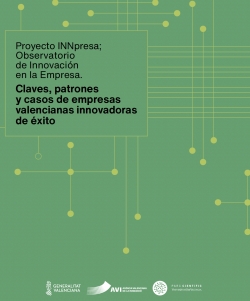
When discussing business innovation, it is common to encounter generic recommendations: invest more in R&D, digitalize processes, or adopt new technologies. However, there are relatively few studies that provide concrete evidence on how companies that are achieving outstanding market results actually innovate.
This is precisely where the value of the INNpresa study lies. Rather than relying on theoretical models, the analysis focuses on Valencian companies that have demonstrated sustained growth, value creation, and continuous innovation activity. The aim is not to highlight exceptional and unrepeatable success stories, but to identify patterns that can serve as practical references for other organizations.
Innovation Is Not a Department—It Is a Strategy
One of the study’s most significant findings is that successful innovative companies do not view innovation as an isolated activity. Instead, innovation is embedded within their business strategy and directly connected to decisions regarding growth, market positioning, and business development.
This insight is particularly relevant for the Valencian Community, where the majority of the business fabric is composed of small and medium-sized enterprises. For many of them, innovation is still perceived as a one-off project or an activity mainly associated with obtaining public funding. The companies analyzed reveal a different reality: innovation is a permanent organizational capability.
Innovation Creates Competitiveness When It Solves Real Problems
Another key lesson is that innovative companies do not innovate for technology’s sake. They innovate to solve concrete customer and market challenges.
The study identifies numerous examples of companies developing new products, optimizing production processes, or creating advanced services because they have detected specific unmet needs. Technology serves as an enabler, but the real driver of innovation is the value created for customers.
Knowledge and People Are Strategic Assets
The evidence gathered shows that internal learning capabilities, talent management, and connections with external sources of knowledge are recurring characteristics among successful innovative companies.
This conclusion is particularly important for a region that benefits from a strong ecosystem of universities, technological institutes, science parks, and research centers. Future competitiveness will increasingly depend on the ability to connect these assets with the real needs of businesses.
The Valencian Community Is Progressing—But So Are Its Competitors
The contextual analysis carried out by INNpresa shows that the Valencian Community has improved its position in European innovation rankings, reaching 121st place among 239 European regions and leading the group of Spanish “moderate innovators.” However, regions such as Catalonia, Navarre, Madrid, and the Basque Country continue to advance at an even faster pace.
This finding carries a clear message: improvement is positive, but it is not sufficient. Territorial competitiveness depends not only on a region’s own progress but also on its ability to close the gap with leading regions.
From Diagnosis to Action
The main contribution of INNpresa is not merely to describe innovative companies, but to transform their experiences into actionable knowledge for other organizations.
To achieve this, the project has produced reports, organized seminars across the five science parks of the Valencian Community, and created an observatory that provides businesses, professionals, and policymakers with access to best practices, real-world case studies, and tools to strengthen innovation capabilities.
Innovation does not happen by chance. It is built through strategic decisions, continuous learning, and the capacity to adapt. Understanding how leading Valencian companies are approaching this challenge offers an opportunity to accelerate the competitiveness of the region’s entire business ecosystem.
https://roderic.uv.es/items/de28ef7a-6bc3-4cb5-8bbf-edd88d623b3e
Mateu, J. M., Barra, R., Abel, I. & Planas, L. (2024). Proyecto INNpresa; Observatorio de Innovación en la Empresa: Claves, patrones y casos de empresas valencianas innovadoras de éxito. Obtenido de: https://doi.org/107203/PCUV-12.
Relevant themes:
Sustainable innovation, Resource efficiency
Relevant tags: Social innovation, Technological innovation, Sustainability, Eco-innovation